
Two mosques stand above all others in Islam, known together as the Two Holy Mosques: Al-Masjid al-Haram in Mecca and Al-Masjid an-Nabawi in Medina. Mecca and Medina are the only two places Islam calls a Haram, a sanctuary whose sacredness may not be violated. This article introduces both, their meaning and their remarkable scale.
Al-Masjid al-Haram, Mecca
The Grand Mosque of Mecca surrounds the Kaaba, the cube-shaped building that Muslims believe to be the first house established for the worship of the one God. The Kaaba is the Qibla, the point every Muslim faces in prayer, and the focus of Hajj and Umrah. Around it lie sites central to the pilgrimage: the Black Stone set in the Kaaba's eastern corner, the Station of Ibrahim, the well of Zamzam, and the hills of Safa and Marwah between which pilgrims walk.
Mecca's sanctuary carries rulings found nowhere else: fighting is forbidden within it, its trees may not be cut and its game may not be hunted. The reward for prayer here is traditionally held to be multiplied a hundred thousand times, and non-Muslims are not permitted to enter the sacred precinct. Successive expansions have made the mosque one of the largest gathering places on earth, capable of holding vast crowds during the Hajj season.
Al-Masjid an-Nabawi, Medina
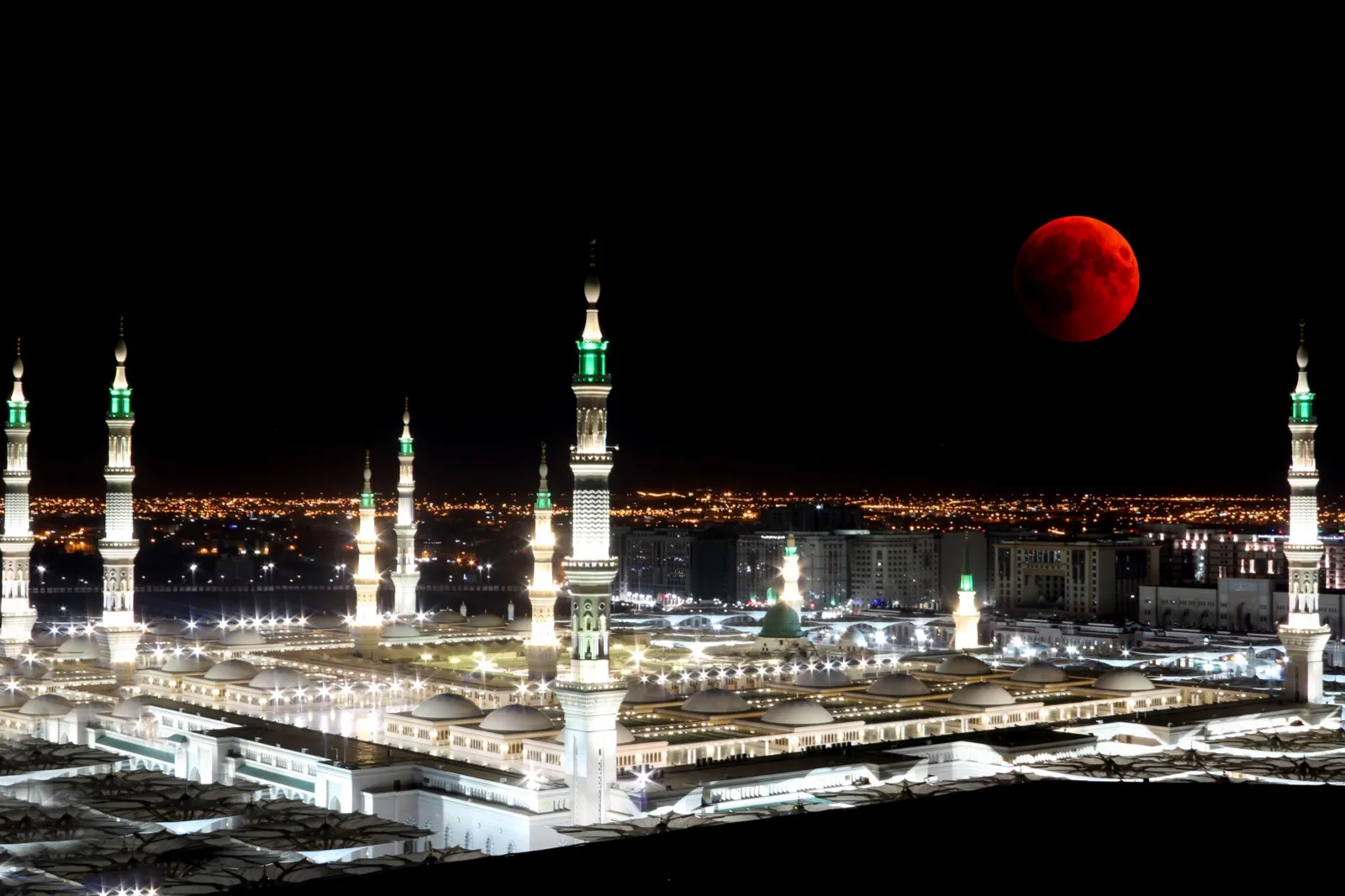
The Prophet's Mosque in Medina was founded by the Prophet Muhammad himself, peace be upon him, beside his home, after the migration from Mecca in 622 CE. It began as a simple structure of palm trunks and mud brick and grew, over the centuries, into a vast mosque crowned by its famous green dome. Beneath that dome lies the Prophet's tomb, alongside those of two of his closest companions. Prayer in the Prophet's Mosque is traditionally held to be worth a thousand prayers elsewhere, and pilgrims often visit Medina before or after the Hajj, though the visit is not itself a rite of pilgrimage.
A living heart of the Muslim world
Together these mosques anchor the geography of Muslim worship. Their history is part of the wider story told in our guide to the short history of mosques, and they stand alongside Al-Aqsa Mosque in Jerusalem in Jerusalem as the three mosques toward which Muslims have traditionally travelled in pilgrimage. Most Muslims will never see them without great effort, yet they face Mecca five times a day. To find a mosque near you, use MosqueFinder to find mosques or explore the the interactive map.